
Trace Anne Arundel County Former Owners
Start with the newest deed reference listed on the SDAT parcel card. That reference is your anchor for walking the Anne Arundel County land records backward, owner by owner.
Each source below answers a different time-depth question, from recent deed transfers to older plat and deed records held by the circuit court.
Keep in mind that a series date shows possible coverage only. Not every page in Anne Arundel County property records is indexed or online.
| Source | Years It Covers | Where Held | What It Shows |
|---|---|---|---|
| MDLandRec index and images | Modern range changes | Maryland State Archives online | Grantor, grantee, deed date, liber and folio |
| Circuit Court land books | Series reach to 1653 | Courthouse and Archives | Earlier conveyances and deed text |
| C2081 county-copy plats | 1863 to 1931 | MSA Plats | Old lots, roads, and subdivision form |
| S1235 subdivision plats | From 1866 | Maryland State Archives | Subdivision names, blocks, lots, and dedications |
The land records portal is the county's deed hub.
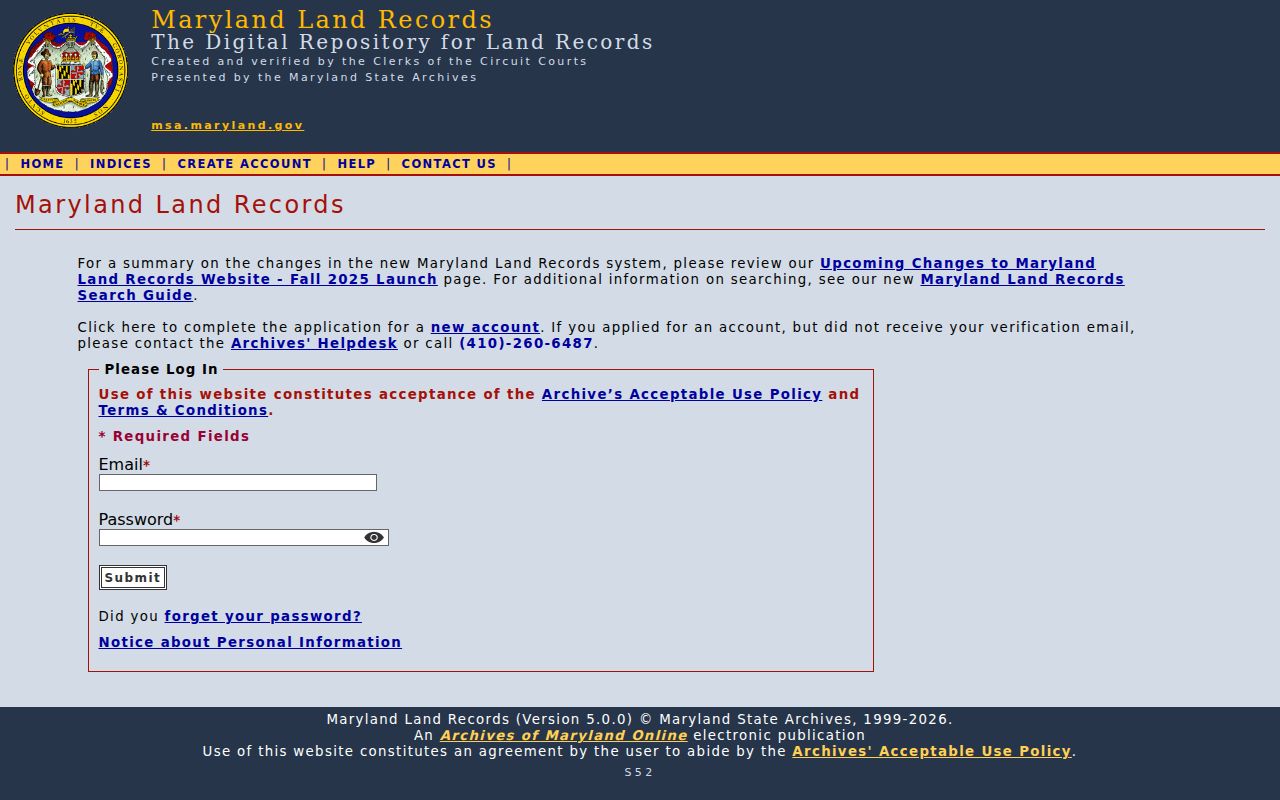
The modern portal is only the starting point. Its deed images reach back to 1967. Anne Arundel County ownership history began long before that. Earlier court books, grantor and grantee series, patent files, abstracts, and tract indexes survive in separate archival series at the Archives. Search by each deed's own citations first, and only then widen to a name search.
Build an Anne Arundel County Timeline
A deed-chain table works best when each row reflects an index entry and its image read together. Add transfers one at a time. A sample row can illustrate the format, but it should never masquerade as a real parcel result from the property records.
| Transfer Date | Grantor to Grantee | Deed Type | Book and Page |
|---|---|---|---|
| Newest recorded date | Prior owner to present grantee | As stated in instrument | SDAT Deed 1 reference |
| Earlier recorded date | Earlier owner to that grantor | As indexed and imaged | Prior deed citation |
| Archival date | Historic parties | Deed, patent, or related record | Archive series and unit |
Keep the recording date and the settlement date in separate columns. Preserve spelling variants, initials, entity names, legal capacity, and the exact parcel description as the deed records state them.
Anne Arundel County Index Search
The Maryland Land Records portal requires a free account. Select Anne Arundel County. Then search for a person or corporation by party type, date, instrument type, book and page, or cross-reference. Name operators include exact, begins with, contains, fuzzy, and Soundex. Start with exact and begins-with searches. Broaden only if those come up empty. A spouse, trust, estate, trustee, or LLC may appear under a different form of the name. The portal's verified-through date moves forward on its own schedule. Indexing can run a day or two ahead of image access.
Walk Anne Arundel County's Chain Backward
Each former owner becomes the next search key. That is the whole method. Match the land itself, not just the name, as you walk the deed chain backward.
- Find the present parcel in SDAT and save Deed 1, Deed 2, legal description, map, parcel, lot, block, and plat.
- Open the latest deed image. Record every grantor and grantee, the recording date, consideration, and cited prior deed.
- Search the grantor as a grantee in an earlier date span. Confirm the same legal description before adding that prior owner.
- Repeat until the searchable index ends, then carry the last liber, folio, tract, or plat clue into Archives finding aids and books.
- Grantor
- The party conveying an interest, usually the seller.
- Grantee
- The party receiving the interest, usually the buyer.
- Chain of title
- The ordered sequence of instruments linking prior owners.
- Reverse index
- An index organized to find a party in the receiving role.
- Quitclaim and warranty
- Different deed forms; neither label alone resolves every title issue.
Anne Arundel County Plats Preserve Place
Street names shift and parcel shapes get redrawn, yet a plat reference keeps its value. Search the Anne Arundel County MSA Plats portal by book and page, plat or box number, right-of-way, date, description, or series. County-copy and subdivision plats can reveal former lot lines, roads, access, drainage, wetlands, acquisition areas, and dedications. Treat a plat as a bridge between deeds. It does not prove that every drawn line is still a current legal boundary. Pair it with the recorded instrument and present survey evidence.
Estates Can Break the Chain
A tidy sale-to-sale sequence often stops cold. Deaths, trusts, court orders, entity transfers, and family conveyances all break the pattern. Search the Maryland Register of Wills estate index for an estate docket, then return to the deed records for the personal representative's deed or another recorded instrument. Anne Arundel County Public Library's genealogy resources, including the Maryland Room, Joan Cass Beck Collection, and Kuethe holdings, add address and family context. A directory entry shows occupancy or association, nothing more. It can never replace the recorded chain of title.
The Pre-1704 Anne Arundel County Gap
An Annapolis fire destroyed most documents predating 1704, according to Maryland State Archives series S1212. A chain that stops there did not necessarily begin there. Patents, tract indexes, and abstracts can all push past the gap. So can chancery and court records, plats, and probate material. City land papers help too. Later deeds reciting an older trail can also push past the gap. Describe what you find with care. Name the last surviving instrument, the date span, and the series searched. Say plainly what the obstacle is. It may be documented loss, an offline image, an unindexed series, or a failed search. That honest record of work beats pinning an unsupported first owner on the property.
Anne Arundel County Chain Cross-Checks
Later deeds can rescue a broken chain. An old tract name may reconnect the pieces. A prior liber and folio, an inheritance note, or a boundary call can do the same. Annapolis municipal land papers and historic directories can test an address clue. Patents and abstracts test a tract. Keep each source in its role. A directory links a person to a place. But only the recorded trail supports an ownership statement.
When two people share a name, compare spouses or co-owners. Also compare legal capacity, the residence stated in the instrument, consideration, lot and block, and the prior deed citation. Entities complicate this too. A company may change its legal name after buying land. So preserve the historic entity name and dated status rather than rewriting an old deed with today's business name.
Anne Arundel County Names Through Time
Names shift even when the land does not. That is the main reason former-owner searches stall in Anne Arundel County property records. A buyer may appear under a maiden name, initials, a middle name, a suffix, or a trustee capacity. Entities may show up under slightly different legal names in consecutive deeds. MDLandRec handles party roles and several name operators. But a fuzzy or Soundex match only becomes useful once it lines up with the legal description, the deed date, and a prior reference in the parcel's chain. Run both grantor and grantee roles for every plausible spelling. Spouses and trusts can appear differently from one instrument to the next.
Businesses need their own dated check. Maryland Business Express lists an LLC's or corporation's legal name, Department ID, filing status, resident agent, principal office, and filed documents. Remember that a resident agent is not the former property owner. Never swap a current entity name into an older deed, either. Keep the exact name each instrument used. If the company merged, dissolved, or renamed itself later, let the filing history explain the transition. Do not rewrite the recorded chain.
Estate transfers break the familiar sale pattern. The Register of Wills search can surface an estate, its personal representative, a filing date, a status, or a claim. Those details guide a search. They do not establish ownership of a specific Anne Arundel County parcel. For that, find the personal representative's deed, a trustee's deed, a court order, or another land instrument. Then verify the same lot, tract, or liber and folio trail.
Historic directories work best after the deed chain fixes a period and an address. The Anne Arundel County Public Library directs researchers to the Maryland Room, the Joan Cass Beck Collection, Kuethe holdings, newspapers, and genealogy databases. These sources can reveal an old street form, an occupant, a business, or a family link. They do not prove title. Call an occupant an occupant and a deed grantee a grantee. Property history then stays separate from an unsupported owner list.
Anne Arundel County Ownership Depth
Archives finding aids trace Anne Arundel County court land records back to 1653. Grantor and grantee microfilm covers 1839 to 1851. Older patent and tract sources are arranged by series. No single guaranteed earliest image year spans every instrument. The real cutoff is wherever a documented parcel-specific search lands.
The courthouse research room sits at 8 Church Circle. Walk-in hours run 8:30 a.m. to 4:30 p.m., and copies generally cost $0.50 per page. The clerk provides access and copies but does not perform a title search. Mail requests need a current book and page plus the page count.
Use the archive responsibly. Former-owner research supports house history, estate work, and purchase diligence. Never use it to track, expose, or harass a living person.